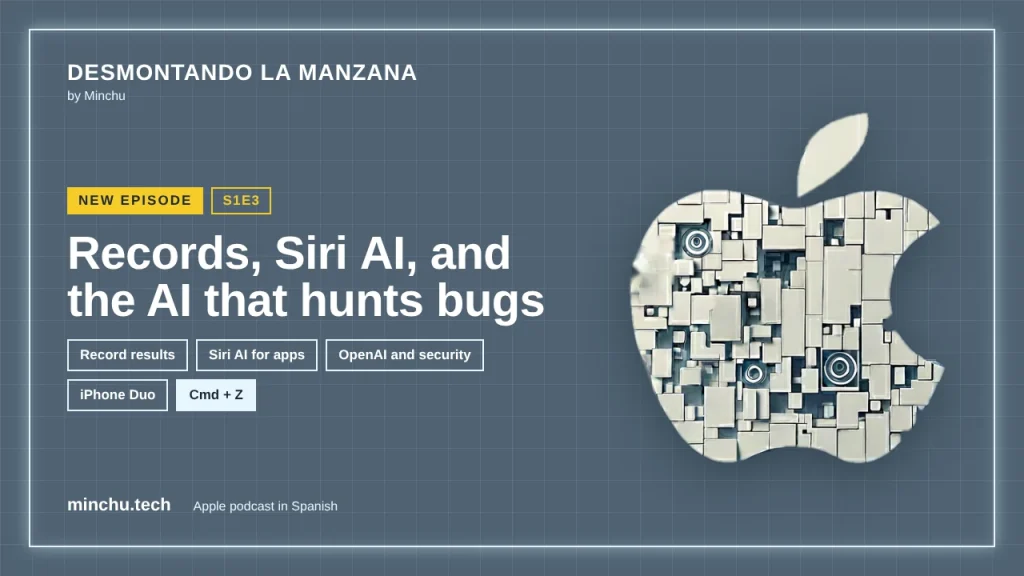
A new episode of Desmontando la Manzana, my Apple podcast (in Spanish). This week Apple posted the best results in its history, opened Siri AI to every developer, and announced an iCloud change I don’t like at all. Outside Apple there’s just one story, but it’s a big one: OpenAI unveiled an AI model built for cybersecurity. Here’s the episode recap, with a bit more context than the audio.
The main event: records for Apple, more pressure on costs
On Monday, November 2, Apple reported $114.5 billion in revenue for its fiscal fourth quarter (July through September), up 12% year over year. That’s a September-quarter record, a record for iPhone revenue ($57.6 billion, up 17%), and an all-time high for Services ($31.6 billion). The full fiscal year closes at about $479 billion, the best in Apple’s history. These are also the first results with John Ternus as CEO, a role he has held since September 1. We broke down every number in Apple’s quarterly earnings.

There’s a less flashy number worth watching, though. For the holiday quarter, Apple expects revenue to grow 7% to 10%, but with a lower gross margin: 45% to 46%, down from 47.9% this quarter. The reasons Apple gave are rising memory costs, which it expects to keep climbing, and the cost of running Siri AI on its servers.
That same week, Apple placed a $7.5 billion bond sale in seven tranches through 2036, with investor demand more than four times the amount offered. Buying bonds doesn’t change anything on your iPhone, but it shows how much money is at stake across the industry: assistants, data centers, chips, and infrastructure.
My take: this doesn’t mean every product gets more expensive tomorrow. But it does raise a question: if making devices costs more and Apple is investing heavily in AI, will it absorb those costs, or will we end up seeing them in prices? Record sales don’t automatically mean a better experience for us. Ternus’s challenge isn’t inheriting a company that makes a ton of money. It’s turning this spending into products we actually notice: a more useful Siri, services worth what they cost, and new features without the entry price drifting further away.
Siri leaves home: Apple opens Siri AI to developers
On Tuesday, November 3, Apple announced a Developer Preview of Siri AI, available in the iOS 27.3, iPadOS 27.3, macOS 27.3, and visionOS 27.3 betas. Through App Intents, any app can bring its actions to Siri AI: checking a delivery, booking a reservation, or placing an order without having to remember every menu and button. The first iOS 27.3 public beta arrived on Thursday, November 5, along with vertical tabs in Safari, adaptive dark mode, and the new Health app.

Some context, though. This is a preview, not a finished feature: Apple says it will reach users in a few months, and apps with this integration can’t be submitted to the App Store until spring. Siri AI is available in the US, but it’s still not on the iPhone in the European Union. We covered the details in Siri AI opens up to all developers.
My take: if Apple wants Siri to be useful, it can’t stay locked inside Apple’s own apps. If this works, we’ll ask for what we want to do instead of first thinking about which app to open. If it doesn’t, it’ll be another AI promise that looks great on stage and that we stop using after a week. That’s the real test.
Outside Apple: OpenAI moves into cybersecurity
OpenAI unveiled GPT-6 Cyber (some outlets call it ChatGPT Cyber), a model built for cybersecurity. It isn’t public: only approved researchers in Daybreak Red, the top tier of OpenAI’s Daybreak security program, can use it. According to OpenAI, it found 81 new high-severity vulnerabilities in Firefox, many already fixed by Mozilla. In the Linux kernel, it flagged about 2,300 potential flaws, reproduced 1,724, and developed exploits for 948 of them. Those figures come from OpenAI itself.
The news comes after a researcher used an earlier OpenAI model to find a serious flaw in software used on Ubuntu that could have let an attacker take over servers. He reported it, Debian shipped a patch, and there’s no evidence it was exploited. OpenAI also announced a $1 billion initiative to support professionals in its program who protect critical infrastructure such as power grids and water systems.
My take: a tool that can review this much code can help find bugs before someone exploits them. But the same capability can make hunting for vulnerabilities cheaper and faster for people with bad intentions. AI doesn’t turn anyone into an attack expert, but it changes the pace: if finding a flaw is faster, confirming and fixing it becomes more urgent too. The challenge is getting these tools to the people who maintain the software we all use, including open-source projects without a big security team behind them.
Apple quick hits: more than 100,000 apps for iPhone Duo
Apple says there are already more than 100,000 apps optimized for iPhone Duo, two weeks after launch. The count covers apps built with the iOS 27.1 SDK or later, which carry the “Made for iPhone Duo” badge on the App Store. WhatsApp, Instagram, YouTube, Netflix, and Microsoft Office are already there, but as of November 6, common apps like Google Docs, Microsoft Teams, and PayPal were still missing.

A big number doesn’t guarantee your apps work well. The practical question is whether your messaging, work, banking, and transit apps are ready, because on a foldable, what happens when you open and close the screen is central to the experience. At a starting price of $1,999, it’s worth checking first. Here’s how to tell whether your apps are optimized.
Command-Z: Apple will check public iCloud links
With iOS 27.3, expected in December, Apple will start checking images in iCloud Photos and files in iCloud Drive that you share with the “Anyone with the link” option, to detect harmful content. It only applies to that kind of public link: not to what you share with “People you choose,” and not to all your private photos. Apple also says content shared that way is no longer end-to-end encrypted, even with Advanced Data Protection turned on.
What bothers me is what Apple doesn’t explain. It doesn’t define “harmful content,” yet it reserves the right to remove that content, block or disable the account, block new accounts tied to the same email or phone number, and even involve law enforcement. It doesn’t say what happens if it gets it wrong or how to appeal. Command-Z to the lack of clarity: if Apple is going to review what we share and can act against our accounts, the rules and the process for fixing mistakes need to be clearly explained. Command-Z.
What do you think?
My takeaway: Apple has historic results and, at the same time, homework to do: proving that its investment in Siri AI turns into features we actually use. Do you like the idea of Siri doing more inside your apps, or would you rather keep each service separate? Tell me in the comments or on X, Instagram, and Threads, where you’ll find me as @minchuaviles.
If you missed the last one, here’s the touchscreen Mac episode. And for the week’s Apple news in one place, check out this week’s edition of La Keynote del Domingo.
Because there are many apples, but few of us who know how to appreciate them.
🎧 Listen to Desmontando la Manzana (in Spanish) on Apple Podcasts and Spotify
Sources: Apple Newsroom (earnings, Nov 2, 2026), MacRumors (earnings and guidance), iClarified (bond offering), Apple Developer (Siri AI, Nov 3, 2026), 9to5Mac (iOS 27.3 public beta), TechCrunch (OpenAI and cybersecurity), BleepingComputer (GPT-6 Cyber), MacRumors (iPhone Duo apps), MacRumors (iCloud links). Data as of November 9, 2026.