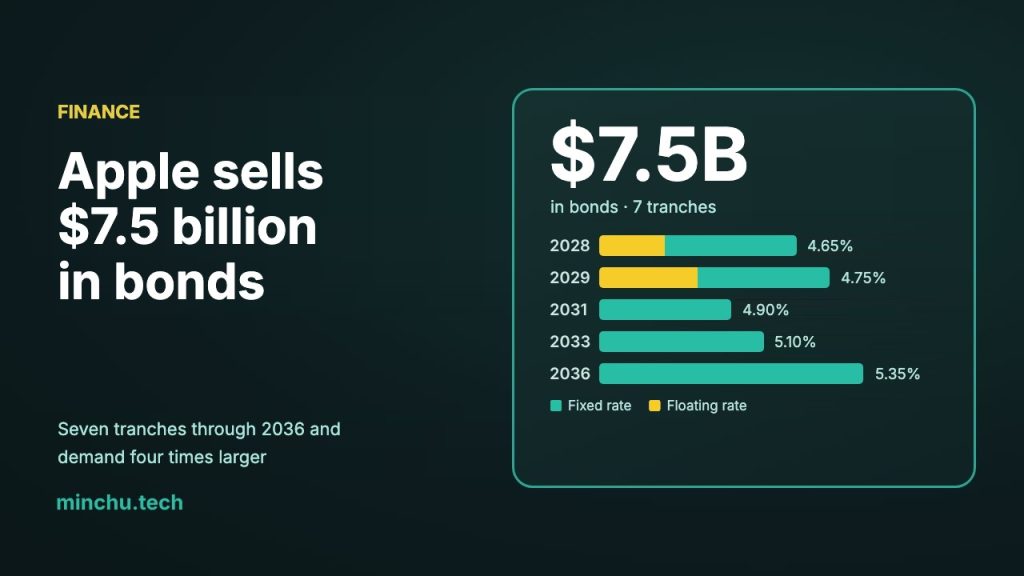
Apple is borrowing from investors again. The company has set the final terms of a $7.5 billion bond offering, slightly more than expected: early reports pointed to about $7 billion. It’s Apple’s first debt offering since May 2025, when it raised $4.5 billion.
Demand far outstripped supply. According to Bloomberg, investor interest topped $30 billion, more than four times what Apple wanted to sell.
The seven tranches
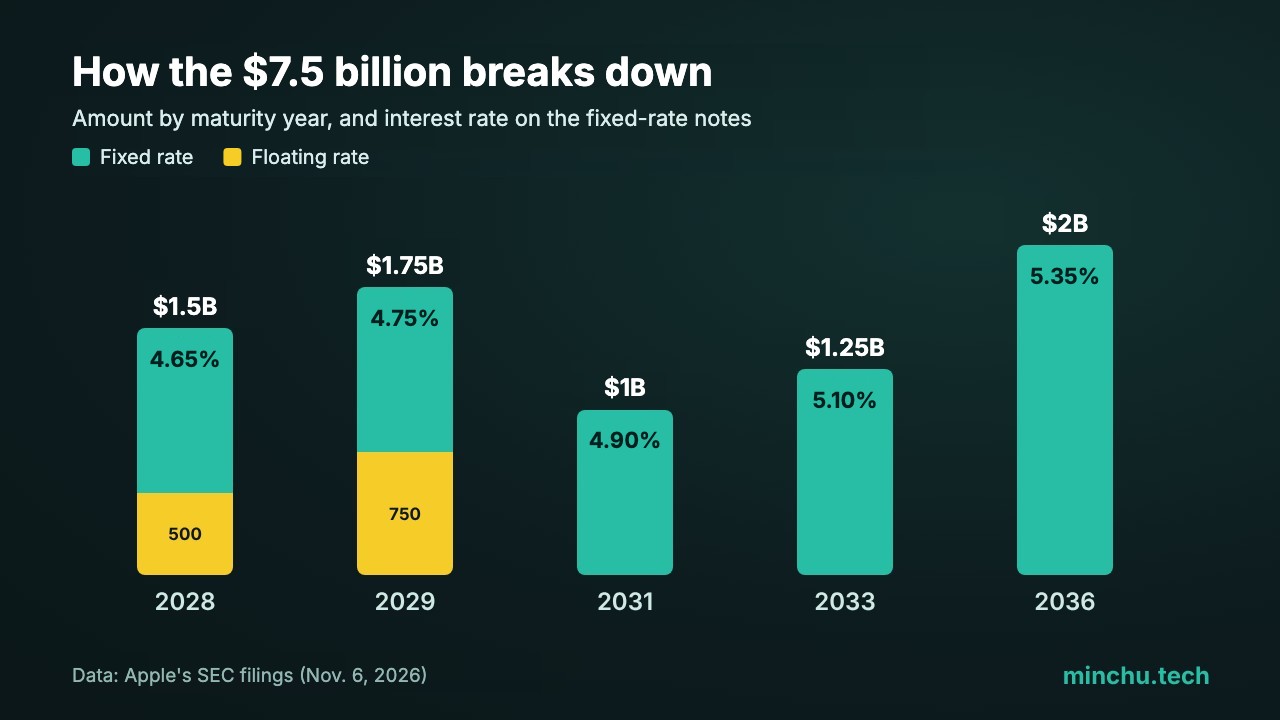
The debt is split into two floating-rate notes and five fixed-rate notes, with maturities between 2028 and 2036:
| Maturity | Amount | Interest rate |
|---|---|---|
| 2028 | $500M | Floating |
| 2028 | $1B | Fixed, 4.65% |
| 2029 | $750M | Floating |
| 2029 | $1B | Fixed, 4.75% |
| 2031 | $1B | Fixed, 4.90% |
| 2033 | $1.25B | Fixed, 5.10% |
| 2036 | $2B | Fixed, 5.35% |
After underwriting fees and other expenses, Apple expects net proceeds of about $7.47 billion.
What does Apple want this money for?
Officially, for “general corporate purposes.” In its filing with the SEC, Apple says these may include share buybacks, dividend payments, acquisitions, and repaying existing debt. It doesn’t say how much will go to each.
Why a company with so much cash takes on debt
It may seem contradictory. Apple ended fiscal 2026 with about $136.9 billion in cash and marketable securities. That same year it earned about $132.2 billion on roughly $478.8 billion in sales. In other words, it doesn’t need the money.
The key is where it goes. In fiscal 2026, Apple spent about $85.8 billion on share buybacks and about $15.7 billion on dividends. On April 30, it also approved a new buyback program of up to $100 billion. CFO Kevan Parekh has said Apple is no longer pursuing its “net cash neutral” goal, the target of matching its cash and debt that had shaped its strategy for years. If it no longer has to spend its cash down to zero, borrowing cheaply to keep buying back shares fits perfectly.
In perspective, the offering is small for Apple: it’s just over 5% of the roughly $145.1 billion in operating cash flow it generated in fiscal 2026.
Does it affect Apple customers?
Not directly. The offering doesn’t change prices, products, or availability. Where it does show is in the strategy: most of this money ends up going back to shareholders through buybacks or dividends. If you want the full context on the numbers, we went over them in Apple’s results for the last quarter.
My take
Apple no longer behaves like a company that hoards money, but like one that hands it out. The fact that investors asked for four times more bonds than were offered shows that Apple can borrow whenever it wants and on good terms. But it also leaves a question: if the money goes mostly to buying back shares, how much is left for innovation? With the iPhone Duo still short on stock and memory driving up component costs, I’d like to see the same ambition in the products as in the buybacks.
Sources: 9to5Mac, AppleInsider, 24/7 Wall St. (Nov. 6, 2026). Figures in dollars from Apple’s SEC filings.