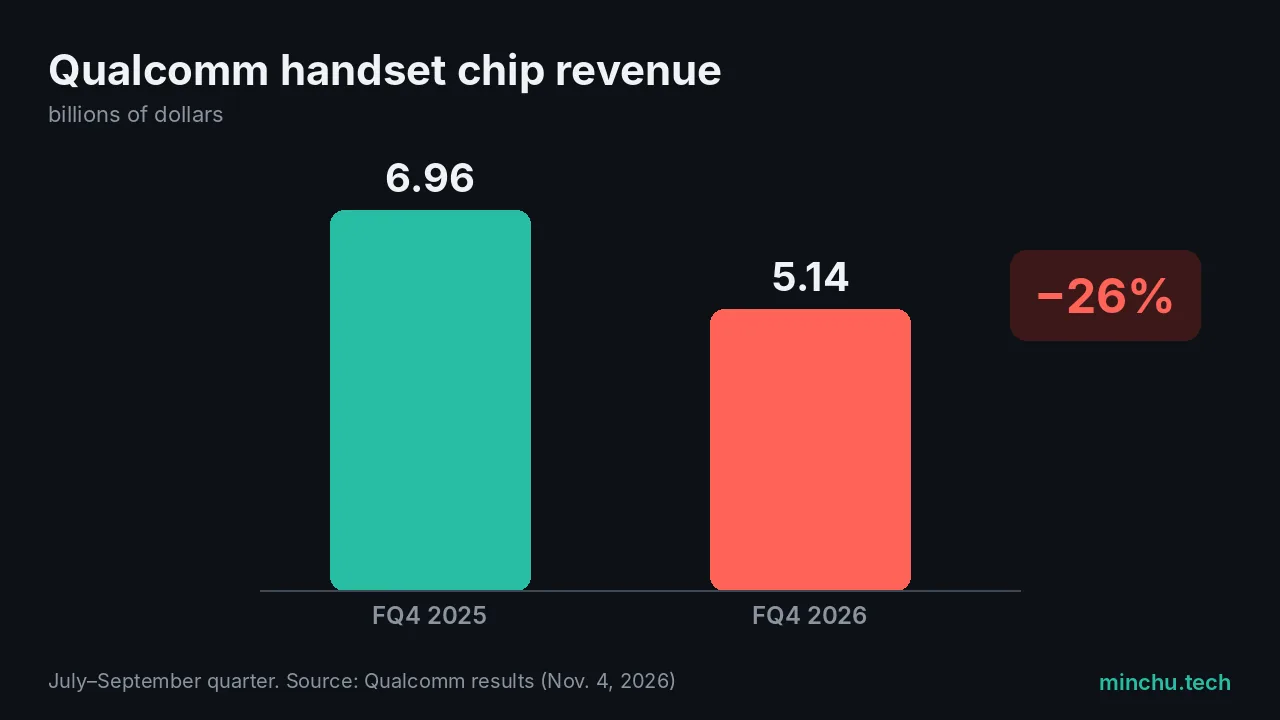
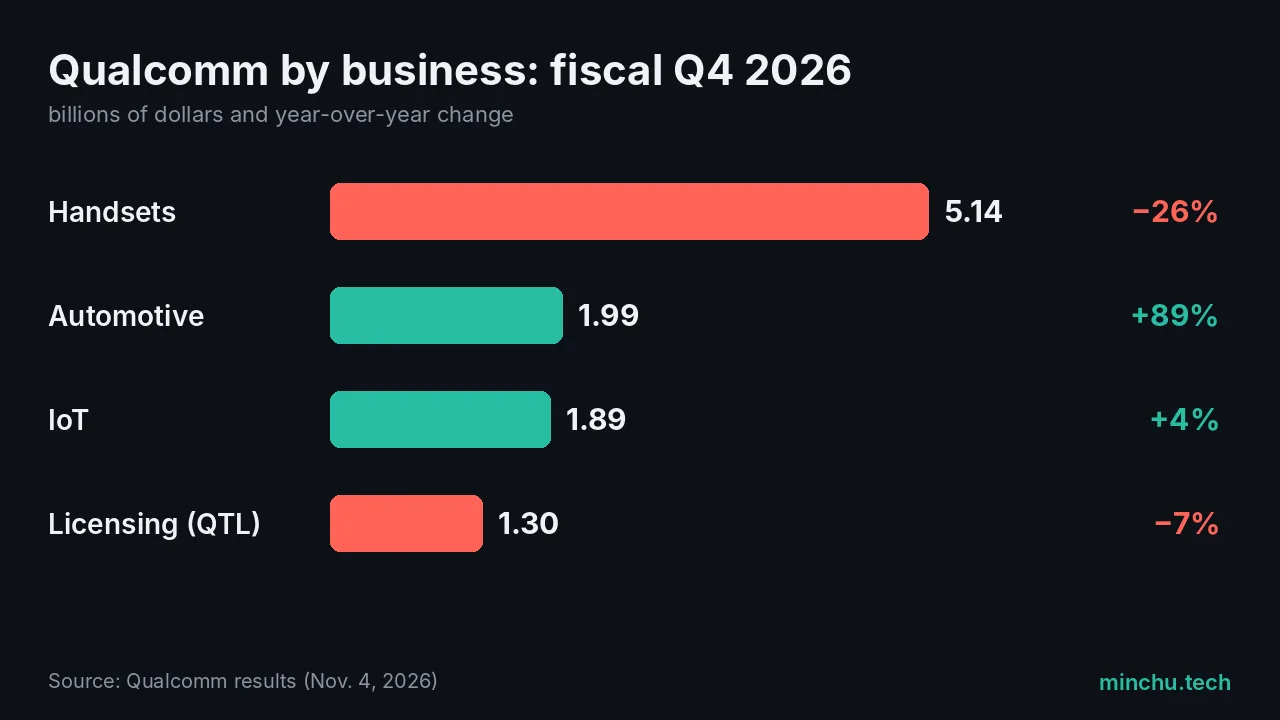
Qualcomm, the company behind the Snapdragon chips inside most high-end Android phones, reported results on November 4 for the fourth quarter of its fiscal 2026 (July through late September). The headline number: revenue from smartphone chips fell 26% to $5.137 billion, down from about $6.96 billion in the same quarter of 2025.
The quarter in numbers
- Total revenue: $10.32 billion (down 8%), or $10.44 billion on a non-GAAP basis (down 7%).
- Adjusted earnings per share: $2.17, down 28% year over year but slightly ahead of expectations.
- Handsets: $5.137 billion (down 26%). Analysts polled by Visible Alpha expected $5.25 billion.
- Automotive: $1.99 billion (up 89%), roughly its first $2 billion quarter.
- IoT: $1.888 billion (up 4%). Licensing (QTL): $1.304 billion (down 7%).
- Full fiscal year: $43.12 billion in revenue (down 3%).
Wall Street wasn’t impressed: the stock fell 6% to 7% in after-hours trading that day.
Why handset chips fell so hard
Three things add up. First, memory: demand from AI data centers has sent RAM and storage prices soaring, so phone makers have cut production and raised prices. Qualcomm says some major customers scaled back their build plans because of memory shortages. Second, the market itself: according to Counterpoint Research, global smartphone shipments fell 20% in the quarter, to a 14-year low. Third, Apple, which is replacing Qualcomm’s modems with its own faster than expected.
For the October–December quarter, Qualcomm expects $10.4 billion to $11.2 billion in revenue and adjusted EPS of $2.15 to $2.35. CEO Cristiano Amon told Reuters the forecast no longer includes any Apple sales, that Android sales have bottomed out, and that non-handset revenue (auto, IoT and data centers) should grow more than 60% next fiscal year.
What it means for you
When the biggest chip supplier in the Android world sells a quarter less, it’s not a good sign for prices. High-end phones are already getting pricier: the Motorola Signature 27 costs $1,599, and Samsung raised the Galaxy S26 from $899 to $999 this fall. Apple also flagged memory costs squeezing its margins in its latest earnings.
My take
These numbers confirm what you can see in stores: memory has become the bottleneck for the whole phone industry, and buyers are paying for it. Losing Apple was only a matter of time for Qualcomm, which is why it has spent years pushing into cars and data centers; the 89% jump in automotive shows the bet is working, but it doesn’t make up for the drop yet. If you’re planning to buy a new Android phone in the coming months, I wouldn’t count on cheaper flagships in 2027. The new models will most likely cost the same or more, and the better deal may be last year’s model on sale.
Have you noticed phone prices going up? Let me know in the comments or on social media.
Sources: Qualcomm results by segment, Reuters (via The Star), InsiderFinance, ShiftDelete, The Crypto Basic, Android Authority (Galaxy S26 prices). Data as of November 9, 2026.